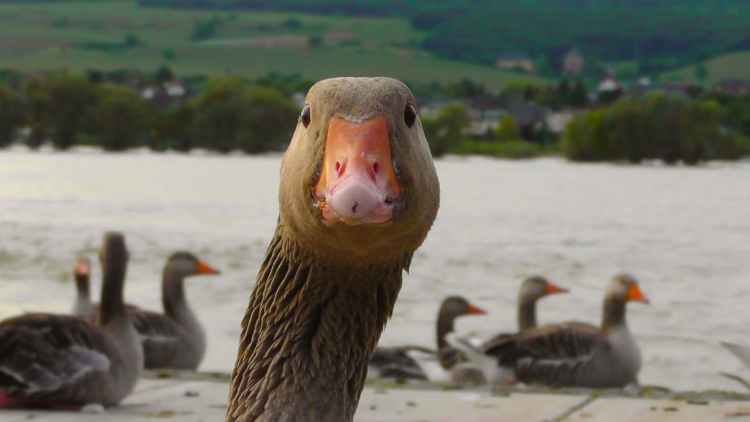
I am not in the habit of calling my teacher a “goose” but for the purposes of this story I want to call my sixth grade social studies teacher (please forgive me, Mrs. Tesla) the “goose that laid the golden egg”. But before I digress further from the story. . .
Once upon a time. . .
there was a fair Lady who spent most of her days residing in a sixth-grade classroom learning how to diagram sentences to show grammatical relationships and putting 856 over 935 to divide and see how many decimal places there were and other complex (and tedious) tasks. One day she was so wearied by trying to decide whether “big” was an adjective modifying “green”, “poisonous” or “apple” that she burst into tears. Her English teacher told her to go to the girls’ restroom and stay as long as she wanted. So she did. She was shut up in the ivory-tiled lavatory for so long that a knight in shining armor was sent to fetch the school nurse to see if the Lady was alright. The Lady returned to class, wan and shaken, and vowing to become a veterinarian who would never have to analyze a sentence.
But at about the same time a strange thing occurred. The Social Studies Teacher, Mrs. Tesla, decided that since the class was studying medieval times in Europe that each student would become a Lord or Lady of a castle. You see, Lady Lucinda had not known she was a Lady until that time. She believed she was just “Elizabeth” or “Tin Lizzie” as her male 6th grade tormentors liked to call her. Now faced with the task of studying about life in the castle so that she could write to a lady in a neighboring castle and describe her castle, life took on new interest.
My Dear Friend Lady Margaret,
Life at our castle is just one big party right now. Lord Albert is holding a jousting tournament and knights from the five kingdoms are attending. We shall have feasting and dancing. The court jesters will entertain and the minstrels will perform.
(“My goodness,” thought Lady Lucinda, “I need to find out what people in castles ate and how knights got invited to attend jousts.”)
On the night before the tournament begins we are holding a large banquet for which we will be serving roast pig. The pig will be brought to the table with an apple in it’s mouth. Everyone will have a trencher to put their meat on. We have to have a lot of trenchers because a lot of knights saw those posters we put up announcing the tournament.
(“Hmm,” the Lady continued thinking, “What are the rules for jousting, anyway? It’s not at all like a game of soccer or even chess, even though chess has knights and kings and queens.”)
As you know, during a joust two knights ride their horses toward each other while pointing a long spear at the other knight. If one of the knights knocks the other off his horse that knight wins. If he just hits the knight he gets points and then the knight with the most points wins.
(“Wow! I think I’ll stick with soccer. What did they do with all those horses in the castle, anyway? Were castles really that big?”)
Our castle isn’t big enough to actually hold the joust inside the castle walls, but we do have a great jousting field not too far outside the walls. We do, however, have stables big enough to keep all of the knights’ horses. We have to have a big stable to keep the horses safe in case the castle is attacked. The serfs are taking care of the horses very well. The horses need a lot of hay, straw and oats, not to mention the water the serfs need to carry in buckets from the well outside the stable to the horse stalls.
(“This is really fun to write this letter to Judy – I mean Lady Margaret.”)
Our serfs seem happy enough although I sometimes think they might prefer to have a few acres for which they had to answer to no one but themselves -where they could be “Lord”. I know that is an odd thought and I may be giving them more credit for thinking than is due.
(“I’ve learned so much about castles and knights and lords and ladies. I’ve even learned about the regular people in castles who really made castles run. All of their lives were so different from life today in the 20th century. I love learning about ‘olden times’, but what I’ve learned most is that I think I like living ‘now’ better than ‘back then’. And who knew learning could be so much fun!”)
I am very much looking forward to receiving a letter from you and learning about life in your castle.
Your Best Friend,
Lady Lucinda
And so it was that Lady Lucinda decided to become a teacher because Mrs. Tesla showed how a Teacher could make learning fun and meaningful to her students – and change their lives.
Hence, the analogy to the goose that laid the golden egg. (Sorry again, Mrs. T, for calling you a goose – but I know you would understand).
 Spinning Straw into Gold
Leave a comment